liesi
liesi is my cooking companion app. You write recipes with AI models, then cook them one small step at a time from a phone or tablet.
It is an invite-only beta.
about 6 weeks
from the first commit to beta testing, in my free time Measured
about ¼ cent
of AI for one recipe Measured
5 models
wrote the same dish, and I read every recipe before choosing one
How sure am I? Every result and estimate carries one of these labels.
- Measured
- A number that was measured, in production or in a test.
- Estimated
- My best estimate, with the reasoning shown.
- Hypothesis
- What I expect to happen. Not proven yet.
- Illustrative example
- Made up to show how it works. Not real output.
Overall value proposition
liesi is for people who cook at home. It writes a recipe from a few words, checks it before you read it, and then takes you through it one step at a time.
- The problem. AI models can write any recipe you ask for, but it comes as a huge amount of text: hard to get as a structured recipe, and cumbersome to cook from. It can also be wrong in ways you only find out at the stove: amounts that do not add up, steps in the wrong order, even the wrong dish.
- The idea. Any recipe you can describe, written by an AI model as a structured recipe, with a cooking flow to cook it from. The model fills in a form, ordinary code checks the form before the recipe is shown, and a separate cooking screen takes you through it one step at a time, with timers that keep real time.
- The evidence. liesi is live, with a handful of beta testers, so there is not much evidence of use yet. What I can show is how it was built: about six weeks from the first commit to beta testing Measured, and an AI model chosen by having five of them write the same dish, reading every recipe and comparing the cost.
What it costs to run
AI costs money on every recipe, so what a cook costs depends on how many recipes they write. These figures are a model, not a result.
- One recipe costs about a quarter of a cent in AI. That is the model I use, for one dish in a test Measured.
- Two usage levels. I assume a light cook writes about 10 recipes a month and a heavy one about 100. That is about €0.022 and €0.22 of AI a month Estimated, and the two levels are a Hypothesis.
- A paying tier is an idea. It would be for heavier use, so that what the AI costs stays in proportion to use.
- What would settle it. A few months of real use: how many recipes a cook actually writes. A handful of beta testers is too few to say yet.
What the cook gets
You are at the counter. The phone is propped against a bowl, your hands are wet or floury, and you keep looking away and losing your place. liesi is built for that moment.
liesi is a hub for recipes. You write new recipes with AI models, and the output is formatted into a recipe that is easy to follow. A cooking flow then breaks the recipe down into smaller tasks, so you can cook with your phone or tablet on the counter top.
It is live and in beta testing.
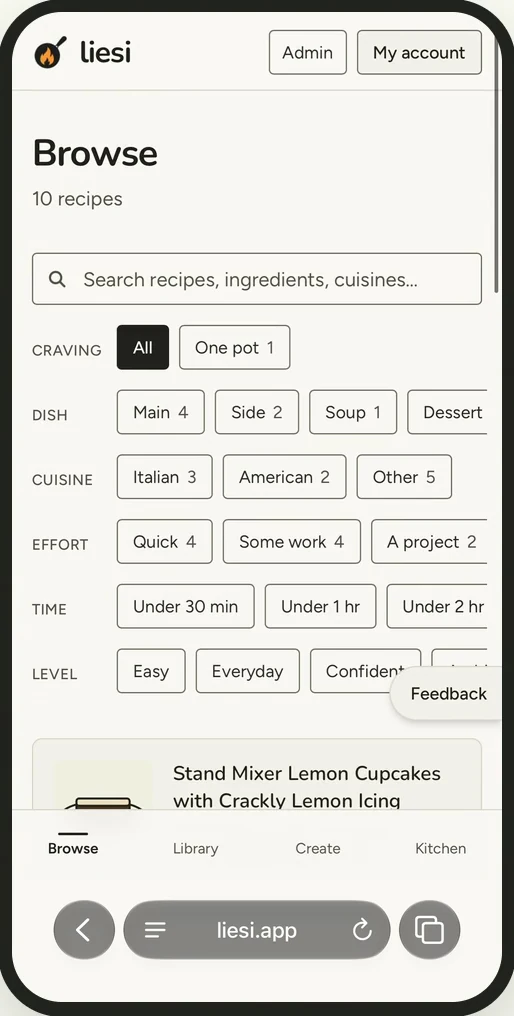
1Discover
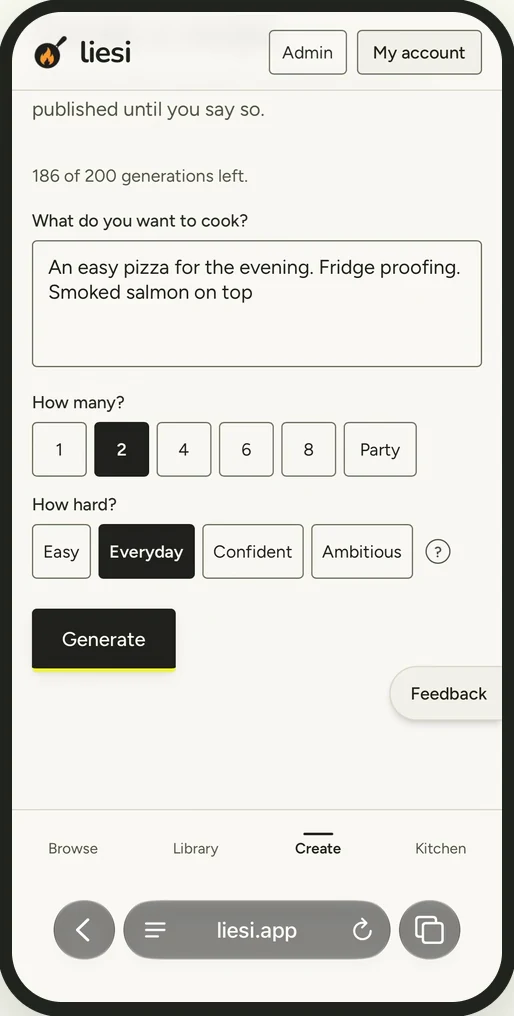
2Create
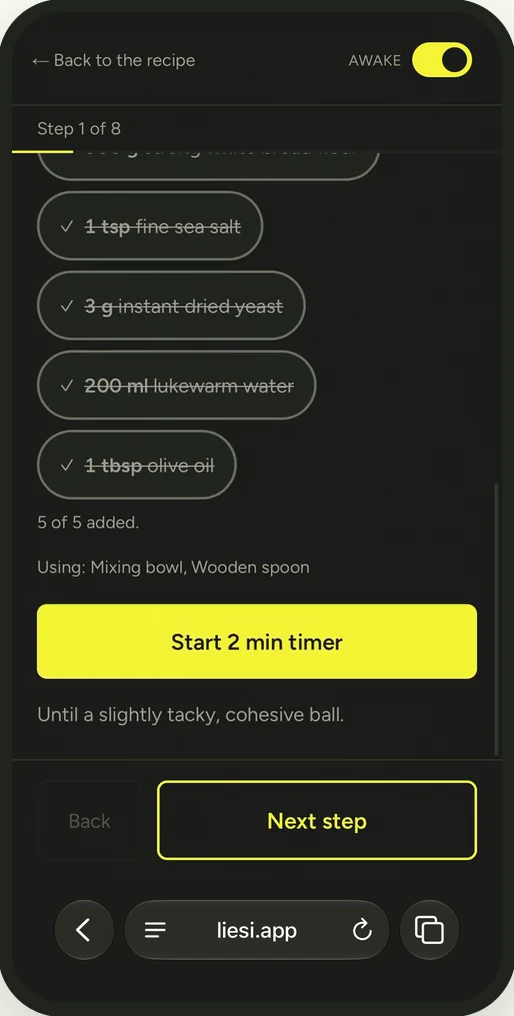
3Cook
The tour
What it does
- Discover. Browse recipes other cooks have published, filter them by effort, time and cuisine, and keep a library of everything you made, saved and cooked.
- Create. Describe what you feel like cooking, with servings and difficulty, and liesi writes a full recipe with amounts, method, timers and multi-day rests. Tap the pen beside an ingredient or a step to ask for a change, for example "No dill, what could I use?", and it rewrites the recipe around it. Saved recipes stay private until you choose to publish them.
- Cook. A separate, dark cooking surface with exactly one step on screen, that step's ingredients to tick off, one-tap timers that keep running across steps, and the screen kept awake. Recipes can pause overnight and keep your place.
How it is built to deliver that
Step 1
The model writes
It fills in a schema, a form for the recipe: ingredients, steps, timers and what each step uses.
Step 2
A validator checks
It checks the arithmetic and the structure in code, with no model involved.
Step 3
A craft score
It is scored separately, from 0 to 1, to catch recipes that pass every rule but are not worth cooking from.
- Pass: It is shown as a draft to read, change and save.
- Fail: It goes back to the model once, with the reasons. If it still fails, the draft is shown with the problems marked.
- Always: A generated recipe is a private draft until it is published on purpose.
Each promise to the cook rests on one decision.
- A recipe that checks out. The amounts add up and common mistakes in step order are caught before you read it.
- Two tiers for generation. The model fills in a schema, then a deterministic validator checks the arithmetic and the structure and can trigger one regeneration at most. Craft is scored separately, from 0 to 1, to catch recipes that pass every rule but are not worth cooking from.
- Your drafts stay private, and the library stays worth browsing.
- Private by default. A generated recipe stays unlisted until you publish it. That is enforced in three places: the query filter, the database's row-level security, and the draft builder. So AI output never floods the discovery view, and share links use rotating tokens, never guessable ids.
- A screen made for the counter. One step at a time, and a timer that keeps real time.
- Two surfaces that share nothing. The cooking surface shares no components with the library card, on purpose. Its timers store an absolute end time and never a decremented counter, so a phone in the background does not stretch a 20-minute timer.
- Easy to read at arm's length.
- One visual idea. Three colours, lemon, dark grey and lime, swap roles between the library, which is light, and the cooking surface, which is dark. A test enforces the contrast ratios.
- No ads and no affiliate deals.
- A plain stack. Next.js on Vercel, with Supabase for Postgres, authentication and row-level security, and Tailwind. A small subscription tier is an idea, to keep AI spend in proportion to use. No ads, no affiliate deals.
What I measured
- Time to beta. About six weeks from the first commit to beta testing Measured, in my free time.
- Five models, one dish, every recipe read. The cost per recipe ran from about a tenth of a cent to about two cents Measured. What separated the models was whether the recipe was the right dish: one wrote a recipe for a different dish, and the craft check gave it a perfect score. So the checks catch amounts and common slips in order, and a person still reads the dish. It was one dish, so it ranks the models. It is not a pass rate.
- Priced against a price rise. One vendor had announced a rise with no figure. I compared the models at today's prices and at five times that vendor's, and chose the one that stays cheapest then Estimated.
Why I built it
The reason I created liesi was that I was using AI LLMs for creating recipes and found that getting a really structured recipe was difficult and then cumbersome to cook from as it is just a huge amount of text. Then I wanted to create a service where you have the cook flow with the limitless options of LLM generated recipes. I made recipes as I like to make food and that is my typical use case for LLMs at this moment. MISE was about recipes and cooking hardware, so came the idea of structured recipe creation with cooking flow.