Intently
People shop for a situation, not a category. I built a working system that answers the situation and explains its picks.
It is a sandbox: what you change in the Studio stays in your own browser session, and the real AI actions are switched off.
12 of 12
tested briefs that the parser understood kept their stated exclusions, such as "no florals" Measured
about €0.003
of AI for one conversation Estimated
Every AI step
is optional: without a key the whole product still works
How sure am I? Every result and estimate carries one of these labels.
- Measured
- A number that was measured, in production or in a test.
- Estimated
- My best estimate, with the reasoning shown.
- Hypothesis
- What I expect to happen. Not proven yet.
- Illustrative example
- Made up to show how it works. Not real output.
Overall value proposition
Intently is for retailers. It helps their shoppers find the right thing in their own words, and gives the people who run the catalogue a way to steer what the shoppers see.
- The problem. Filters make the shopper translate their life into the shop's taxonomy. When that fails they leave, or they buy the wrong thing and send it back.
- The idea. The engine decides, the language model phrases. Every AI step can fail and the product still works, because the plain code underneath is complete on its own.
- The evidence. The checks run automatically on every change, and the weak spots are written down next to the strong ones.
What it could be worth
A lite business case for a made-up mid-size fashion retailer. The numbers are a model, not a result: the retailer is invented and the uplifts are my assumptions.
- The retailer. €20 million of online sales a year, an €80 average order, and 30% of orders returned Illustrative example.
- The benefit. About €110,000 to €690,000 a year, and about €300,000 in the middle case Hypothesis. It comes from two places: guided, explained discovery lifts conversion and order size, and fewer orders come back because the explanation sets expectations before the purchase. The range depends mostly on how many orders go through it, which I assume is between 15% and 40%.
- The cost. About €0.003 of AI per conversation, which is €147 to €980 a year at 150 to 1,000 conversations a day Estimated. The real cost of adopting it is integration and merchandiser time, not AI.
- What would settle it. A pilot on the retailer's own traffic: how many shoppers use it, conversion against a control group, order value and return rate.
What the shopper gets
Online shops ask you to think in their categories. People think in situations: a garden party, it might get cold, nothing floral.
I built Intently to answer that directly. You describe the situation. It asks one or two questions if it needs to, then shows a short list and says why each piece is there.
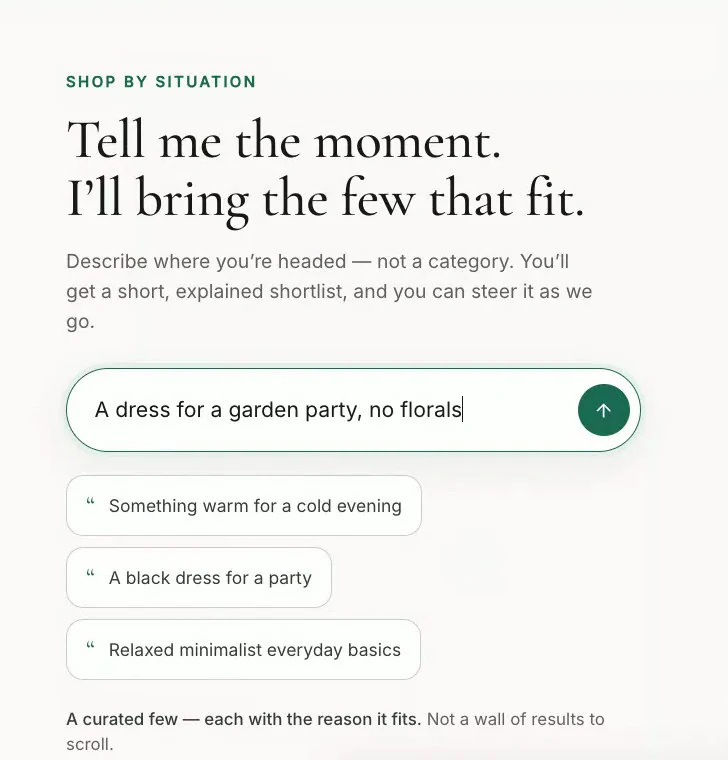
1Describe the situation
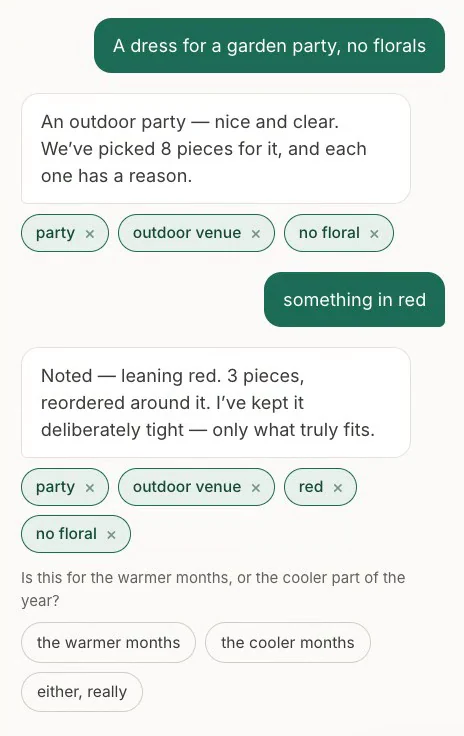
2Adjust it in plain words
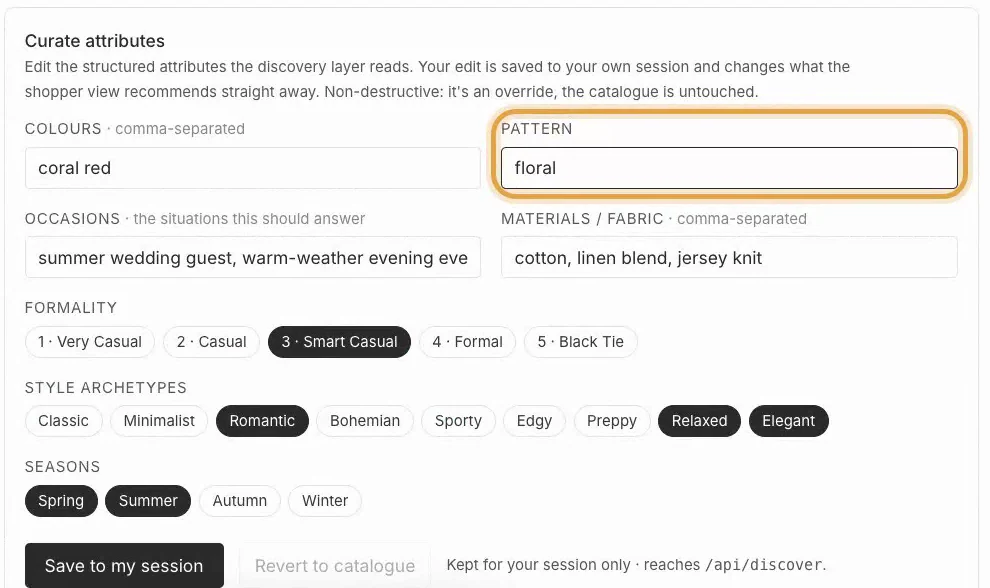
3Correct it in the Studio
The shopper is not the only person I built for. The merchandiser, who runs the catalogue, is the other: in the Studio they correct what the system knows about a product, and what shoppers see changes.
It runs in the open. You can use the shopper view and the admin Studio behind it yourself.
How it is built to deliver that
The design decision I care most about: the language model never decides what to recommend. Ordinary, testable code chooses, ranks and excludes. The model only reads your words and phrases the answer. That is why I can explain any recommendation, and why the running cost stays small.
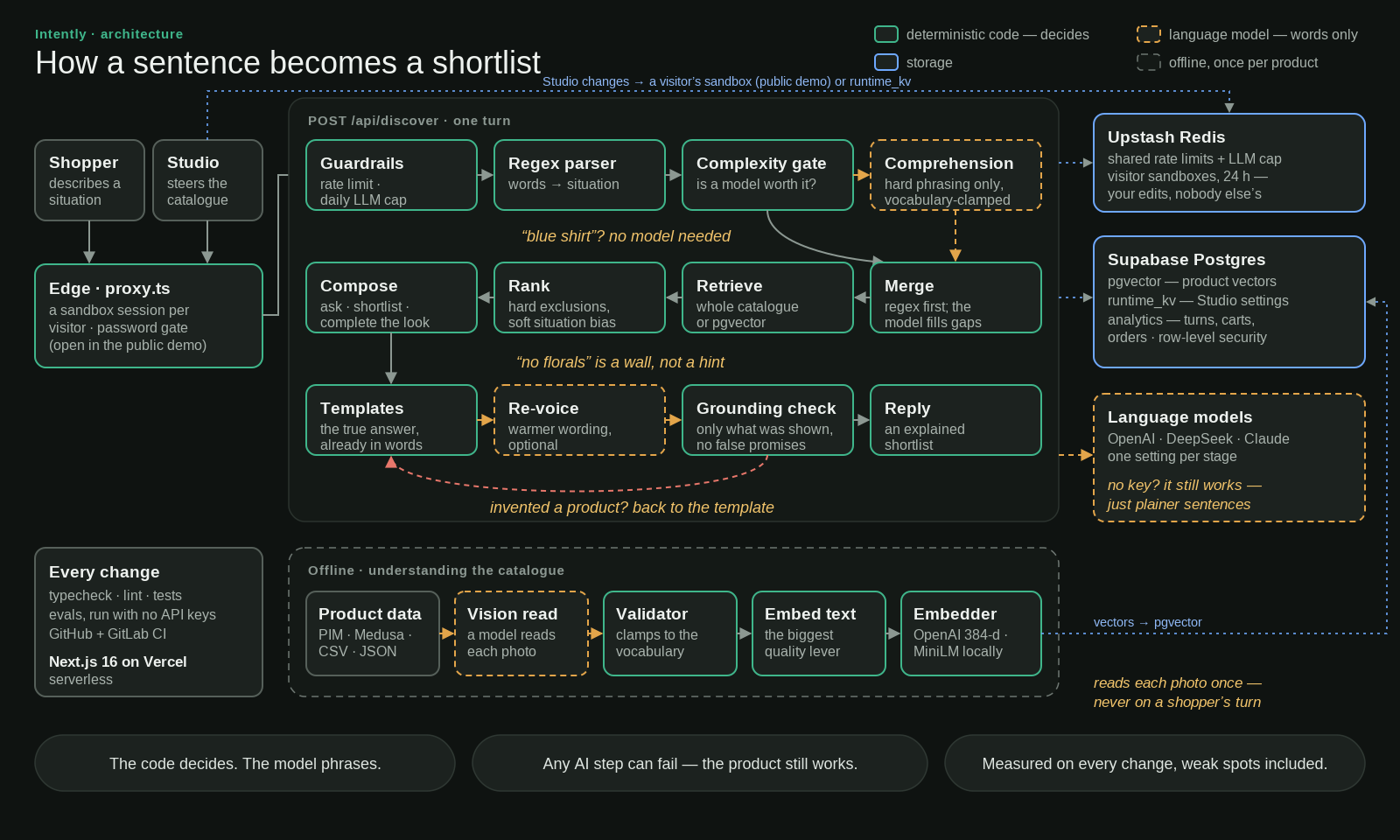
Each promise rests on one decision.
- You say it in your own words. A plain parser reads the sentence first. A language model is called only when the phrasing is hard, and what it returns is clamped to the shopping vocabulary. A short ask like "blue shirt" never waits for a model. Decision records 0001 (opens in a new tab) and 0002 (opens in a new tab).
- "No florals" means no florals. Exclusions are hard walls in ordinary code. The model can only reach them through a deterministic guard, and it fills gaps but never overrides the parser. Decision record 0003 (opens in a new tab).
- It asks before it guesses. The engine picks the question that tells it most about the live inventory. No model chooses it. Decision record 0001 (opens in a new tab).
- Every pick comes with a reason, and none is made up. The engine writes the reason from its own decision. A model may only reword it, and a check throws the wording away if it names a product that was not shown or promises something the shop cannot do. Decision records 0001 (opens in a new tab) and 0004 (opens in a new tab).
- The merchandiser can see why, and fix it. Every result can be explained from the product's attributes. Those attributes are built once, offline, by a model reading each photo, checked against a fixed vocabulary, and shown in the Studio with where they came from. Decision records 0005 (opens in a new tab) and 0008 (opens in a new tab).
- It stays fast, cheap and up. Every AI step is optional: without a key the whole product still works, with plainer sentences. A daily cap limits what the AI can spend. Decision records 0002 (opens in a new tab) and 0006 (opens in a new tab).
What I measured
- Stated exclusions ("no florals") respected in every tested brief the parser understood: 12 of 12 Measured.
- A guard against the model promising actions ("I've ordered it") catches 100% of phrasings it was tuned on, about 30% of new ones Measured — and the reason the next step is to restrict what the model may write, not to add rules.
- AI cost per conversation: about €0.003 Estimated from prompt sizes and list prices.
Why I built it
MISE was my first project: combining recipes with the kitchen tools they need. It taught me how much depends on context — knowing what goes together in the real world. Intently came from the next question: how can we enrich product data using pictures? That needed a picture-heavy catalogue, so I took the conversational side into a clothes shop.
I began to think more about how context determines the quality of the output. When you have rich input, such as a clothes shop's product information management (PIM) system enriched with machine-read pictures, you can have a deep understanding of each product. Managing this amount of PIM data is laborious, and AI tools can scale the solution. Then comes the conversation: understand the intent and provide a curated list of products, compared with large clothes web stores with thousands of products. I wondered how you could build a high-end tailoring service into the web store.